

|
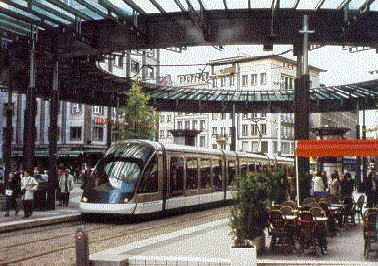
Next time you are in Strasbourg, as I used to be regularly some years ago, make sure you examine the stops on the excellent and expanding tramway—assuming you are not already in Strasbourg and/or are already examining the tram stops there. You are unlikely to spot any members of the Strasbourgeoisie looking attentively at anything other than the 'next tram' indicator, or they may stare inattentively along the tramlines. Tourists who sensibly use the tram whenever possible rather than taking taxis may puzzle over the route map and the ticket machine. But they may be overlooking the feature that makes the Strasbourg tramway unique: the texts displayed at the top of the broad columns near the centre of each platform. ÉMILE MATHIS (1869-1954) Pseudonym of Henri Matisse, painter, twin brother of painter Henri Matisse (1869-1954). He chose this pseudonym to avoid any attribution errors. Nonetheless, his style is similar to that of his brother and their works were, and still are, often confused. Which you have to admit is no less entertaining than the potted biography of the true Emile Mathis (1880-1956; Strasbourg-born motor manufacturer who split from Bugatti in 1910 to establish his own marque). |
At the Porte de l'Hôpital, close to the hotel where I used to stay, one of the texts on one side of the tracks reads in translation as follows: PORTE DE L'HÔPITAL (actually Philippe de la Porte de Dieuleveult de l'Hospital), Strasbourgeois inventor (1689-1749). — Unfortunate inventor of perpetual motion (see detailed notice opposite). Cross the tracks and you find this text: PORTE DE L'HÔPITAL (actually Philippe de la Porte de Dieuleveult de l'Hospital), Strasbourgeois inventor (1689-1749). — Unfortunate inventor of perpetual motion (see detailed notice opposite). Finally, the sixth text is a short 'story' using only words that can be formed from the letters of the name of the stop. As these cannot be translated successfully, here are some of my own, based on the stops I most frequently used. Porte de l'Hôpital Homme de Fer Baggersee The texts on the A line of the Strasbourg tramway are available on an unofficial website. Warning, especially to American readers. |
How to identify the difference:
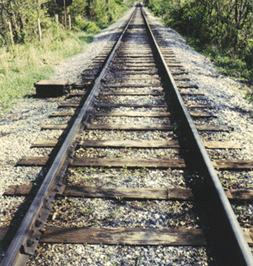
Homme de Fer tram stop in Strasbourg, France (left); Strasbourg Railroad, Pennsylvania, USA (right)
[Photos: ETSU/europa.eu.int; David Fisher]